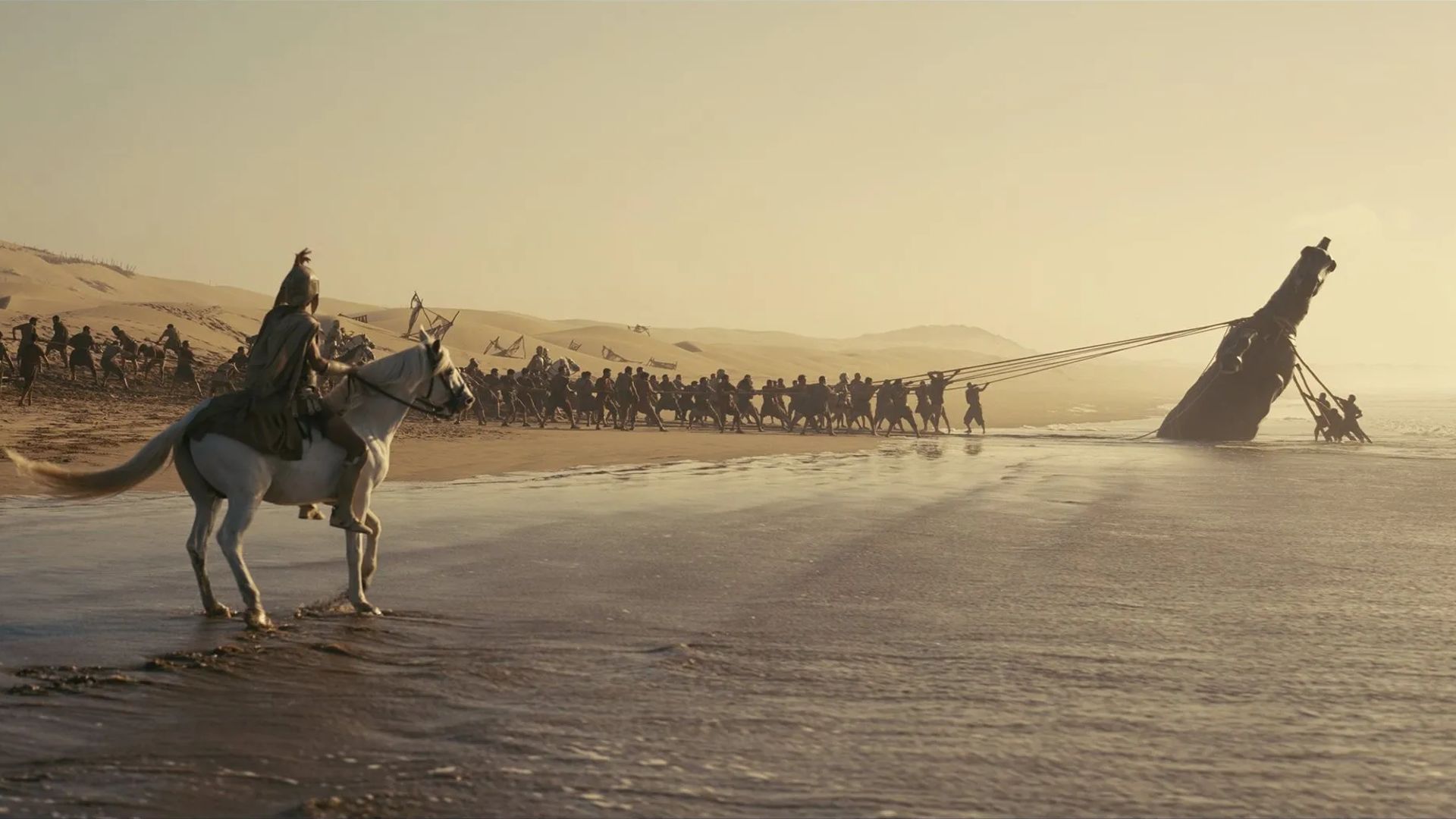
Adapting a classic work of fiction is always a difficult proposition. There have been a few attempts to turn the Homeric epics into movies and TV shows. Wolfgang Petersen’s Troy (2004), starring Brad Pitt, was a flawed but worthy attempt that we discussed extensively in our podcast. The TV show Troy: Fall of a City (2018) was pretty bad. As far as the Odyssey is concerned, I have always had a soft spot for the mini-series starring Armant Assante (1997).
I don’t have a particular soft spot for the subject of this review, however. Christopher Nolan’s The Odyssey looks great: brighter and less funereal than the trailer led me to expect. What we get instead is a handsome, often sun-warmed spectacle that settles quickly into a register I can only describe as generic ancient fantasy, something along the lines of Xena: Warrior Princess. There are fantasy bracers and (leather?) armour galore, pseudo-Corinthian helmets, and so on. The Trojans seem to wear sets of white armour that, frankly, look ridiculous. Agamemnon, the Greek commander-in-chief, appears to wear dark sci-fi armour. The list goes on and on.
But who cares? Homer’s poem about the struggles experienced by Odysseus and his men on their way home from Troy is fantastical. The king of Ithaca encounters a variety of monsters, witches, and spirits on his way home, so who cares about historical accuracy? Well, apparently Nolan does, given that there are misguided but wholly earnest attempt to historicize the adventure.
There are references to the “Age of Bronze”, characters talk about “civilizational collapse”, and an impending “Age of Darkness”, brought about by “Peoples from the Sea”. These are all references to a mostly nonsensical idea about the historical Bronze Age being brought to an end by seaborne raiders. Not only are these references completely out of place; they actively distract from whatever points the movie is trying to make. When, toward the end of the movie, Penelope (Anne Hathaway) intones that “Our civilization is collapsing”, it starts to feel like a joke.
Another example of this attempt to find some kind of truth behind the myth is Polyphemus, the Cyclops. We encounter him early in the movie. He is a giant, but rather than depicting him as the usual cyclops, he is instead shown to have a deformed face: his one eye is awkwardly placed towards the centre line of his face, but with a slight angle; his nose is crooked. This is not a creature of myth; this is someone with a facial disfigurement. Was Nolan afraid that a modern audience would not otherwise accept the existence of a Cyclops?
But the real failure sits at the centre, and it is a strange one for a film about Odysseus (Matt Damon): the cunning has been drained out of the infamously cunning man. We are told how clever he is, but we are shown him doing very few clever things. The Polyphemos sequence is again instructive. In the poem, Odysseus tells the Cyclops that his name is “Nobody”. When he later blinds the Cyclops to give himself and his men an opportunity to escape, the creature calls for help to his brothers on neighbouring islands. But since he says he’s being attacked by Nobody, no one comes to his aid. It’s a clever bit of trickery that was sadly not included in the script.
The film’s Odysseus instead does something fundamentally stupid. Having managed to escape the Cyclops’ cave, Odysseus decides to shoot the giant monster with an arrow. This directly leads to the death of more of his men. I have no idea who thought this would be a good idea.
Matt Damon does not help. His Odysseus is monotone and curiously checked out, seemingly uninterested in what is happening around him. Perhaps it is meant as trauma: the film gestures at post-traumatic stress, at a man hollowed out by what the Greeks did to Troy. On screen it registers less as damage and more as absence: he is arguably the weakest thing in his own movie. (Owen Rees suggested to me that Nolan may have read Jonathan Shay’s book, Odysseus in America.)
Structurally, the film manages the odd trick of being both overstuffed and slack. Cramming the entire poem into three hours means the great set-pieces come and go in a rush: the Sirens, Scylla, and Charybdis blur past almost before they’ve registered. The encounter with the Laestrygones strikes me as entirely superfluous: Odysseus and his men land on an island and spot someone in armour. This person turns around and is clearly a child. It screams, and the giant adults emerge from behind a low hill, clad in armour and wielding weapons, as if they had conveniently been hiding to ambush Odysseus. It feels like padding.
Meanwhile, the movie drops other things that maybe should have mattered more. There is no Scheria, so we lose the moment where Odysseus finally begins to catch a break on his long voyage home. Telemachus (Tom Holland) spends time with Menelaus (Jon Bernthal) and Helen (Lupita Nyong’o) at Sparta, but never meets Nestor, the wise king of Pylos. And yet, having sprinted through so much, the film’s ending still seems to take forever. A tighter script, another pass or two, might have found the taut two-hour movie hiding inside this one.
Then there is the action, which Nolan appears to regard as a chore. The fights are bland and perfunctory, staged with a shrug; you won’t find the careful combat choreography of Troy (2004) here. And the archery – I cannot stress this enough – is among the worst I have seen in recent memory. Every bow on screen is a slack Hollywood prop with no tension in the string whatsoever, drawn back with no visible effort and loosed as casually flicking a light switch. In one hunting scene, Menelaus and Telemachus lazily stroll around, apparently wearing some armour for no apparent reason, and idly loose arrows at birds. It looks amateurish, and it fatally deflates the one payoff that should have landed hardest: the slaughter of the suitors, robbed of all weight by the limp bows and the film’s oddly bloodless restraint. This is, remarkably, an R-rated film with barely any blood or guts in it.
The rest of the cast is pretty strong. Anne Hathaway gives a genuinely good performance as Penelope. Elliot Page is excellent as Sinon, the Greek warrior left outside the Trojan Horse. Zendaya’s performance is outstanding. Charlize Theron’s Calypso is perfectly acceptable and gets a good scene or two. John Leguizamo is very good as Eumaeus, Odysseus’ loyal shepherd. Robert Pattinson is his reliable self, though he is handed almost nothing to do. This leaves the disappointments: Damon, and a visibly adrift Tom Holland, who never quite seems to know what he is meant to be doing, and whom one rather pities for being typecast, yet again, as “The Young One”. It also raises the accent question: why is everyone American? Why not let Pattinson and Holland keep their own voices? Although Troy had everyone, poor Brad Pitt included, speaking the “Queen’s Latin”: must be a feature, not a bug?
The single most inspired thing in the film is also its most unsettling: the transformation scene at Circe’s, an eating sequence so genuinely disturbing that it lingers long after the rest has faded. It is a moment where Nolan seems fully awake, even if it’s sadly undercut, inevitably, by yet more terrible archery. Another inspired scene is when Odysseus makes a blood sacrifice to the spirits of the dead, and the shades rise from the soil.
What the film is reaching for, beneath all this, is the theme of the difficult homecoming: an Odysseus who has lost his way, who may not really want to go home at all, weighed down by the trauma of Troy. It is not especially Homeric, but it’s a defensible angle, and a better film would have committed to it. This one keeps flinching, losing the very thing that gives the movie its moral weight. Homer’s poem runs on xenia – the sacred obligation of host to guest –and the suitors damn themselves by trampling it. Here, the suitors are simply cartoons: evil in the broad daylight way of pantomime villains, never once feeling like a genuine threat.
By the end, Penelope and Odysseus set off together on another sea voyage. One would think that the man had had enough of boats. Odysseus voluntarily goes into exile to leave the throne to Telemachus, a concern he never had in the original stories, and matters of succession are never straightforward in Homer. They sail off to the West, as if they had wandered in from a different, more Elvish epic, with a closing promise that civilization will rise again, for whatever misguided reason.
I finished Nolan’s Odyssey feeling almost nothing at all. I don’t particularly like it nor dislike it. It looks good and is competently enough made, apart from the terrible fight sequences and abysmal displays of archery. It is performing incredibly well at the box office and has caused more people to buy translations of the epic poems and get interested in ancient Greece. That’s always a good thing, so well done, I suppose.