It’s hard to imagine that the original Street Fighter was released all the way back in 1987. I never played it. I guess I may have been a tad too young? The game itself was also rather clunky. It did lay the foundation for the fighting game genre: one character versus another, health bars prominently visible in the interface, buttons to allow a player to punch and kick, and even options to execute tricky motion inputs to perform special moves. Plus, it introduced us to Street Fighter’s main characters, the Japanese warrior Ryu and his American friend, Ken.
Even if I never really experience the original game back when I was young, I did play and absolutely loved its far superior sequel, Street Fighter II, which was released in 1991. As a teenager, my mother would regularly take us to Scheveningen in the Netherlands – close to The Hague – where we got to play in the arcades, which were still a thing back then. The game was a lot smoother and more sophisticated, and would be emulated by countless others with varying degrees of success.
Street Fighter II was a hugely popular game and the publisher, Capcom, released a series of updates. I’m pretty sure I never played the original Street Fighter II – it must have been one of the later editions, possibly Champion Edition (1992) or The New Challengers (1993), which introduced the character Cammy, a British brawler, who I have played fairly consistently over the years as my main character.
The success of Street Fighter II and its various updates cannot be overstated. 1994 saw the release of two movies, Street Fighter II: The Animated Movie and the live action Street Fighter, which starred Jean Claude van Damme but is mostly remembered for Raul Julia’s wonderful turn as the villainous M. Bison. Unlike the animated feature, it’s not a particularly good movie, but it is fairly entertaining.
The success of Street Fighter II: The Animated Movie (1994) in particular paved the way Street Fighter Alpha: Warrior’s Dreams (1995), which got two “sequels” of sorts in the form of Alpha 2 (1996) and Alpha 3 (1998). Opinion is divided on whether the second or the third Alpha game is the best. These games featured a more anime-inspired style similar to the movie.
However, the first true sequel to Street Fighter II, Street Fighter III would not be released until 1997. It replaced most of the iconic cast with newcomers, some of whom were – rather unfairly – derided as “weirdos”. The gameplay was criticized, too, as being not up to the quality of the earlier games. It got a major revision in the form of 2nd Impact in 1997, but it wasn’t until 1999’s 3rd Strike that the game had reached a state that it could be compared with the vaunted Street Fighter II. Funnily enough, 3rd Strike’s popularity seems to have increased in the decades following its release, and it’s now widely regarded as one of the greatest fighting games ever made.
Nevertheless, as Street Fighter III hadn’t been particularly successful for Capcom, the series lay dormant until the release of Street Fighter IV in 2010, which is narratively speaking a sequel to Street Fighter II and a prequel to 3rd Strike. The game caused a renaissance in fighting games, and it marks the time when I got back into fighting games, too. The fourth version got various new editions, as well as version for the Nintendo DS that wasn’t half bad. A direct sequel, Street Figher V, followed in 2016 and had a disastrous launch, lacking even basic features: it was clearly rushed out of the door, but it improved over time to the point that it became a really good game.
And in 2023, Capcom published the latest mainline instalment, Street Figher 6. While the series as a whole has always done well, the latest iteration has enjoyed the greatest success since Street Fighter II. It features a refined combat system with a new “drive system” that allows for fresh defensive and offensive options, some of which, along with the overall style, seem to reference 3rd Strike in particular, which is understandable since this entry is a direct sequel, narratively speaking, to that instalment. The classic controls, with light, medium, and heavy punches and kicks, returns, alongside a brand new control scheme, called Modern, which makes special moves easier to input at the cost of them doing 20% less damage.
Street Fighter 6 also moves the series further into the future: all of the original characters are older and wiser, and a fresh cast of new characters has been introduced. And this article will focus on one of these new characters.
Enter Marisa
The diverse cast of characters in the Street Fighter games, usually referred to as the “world warriors”, are intended to represent, with few exceptions, citizens of specific real-world countries. Ryu is from Japan, Ken and Guile are from the United States, Cammy is from the United Kingdom, Zangief is a grappler from Russia, and Dhalsim is from India. Newcomers include Manon (France), Lily (Mexico), and Kimberly (United States).
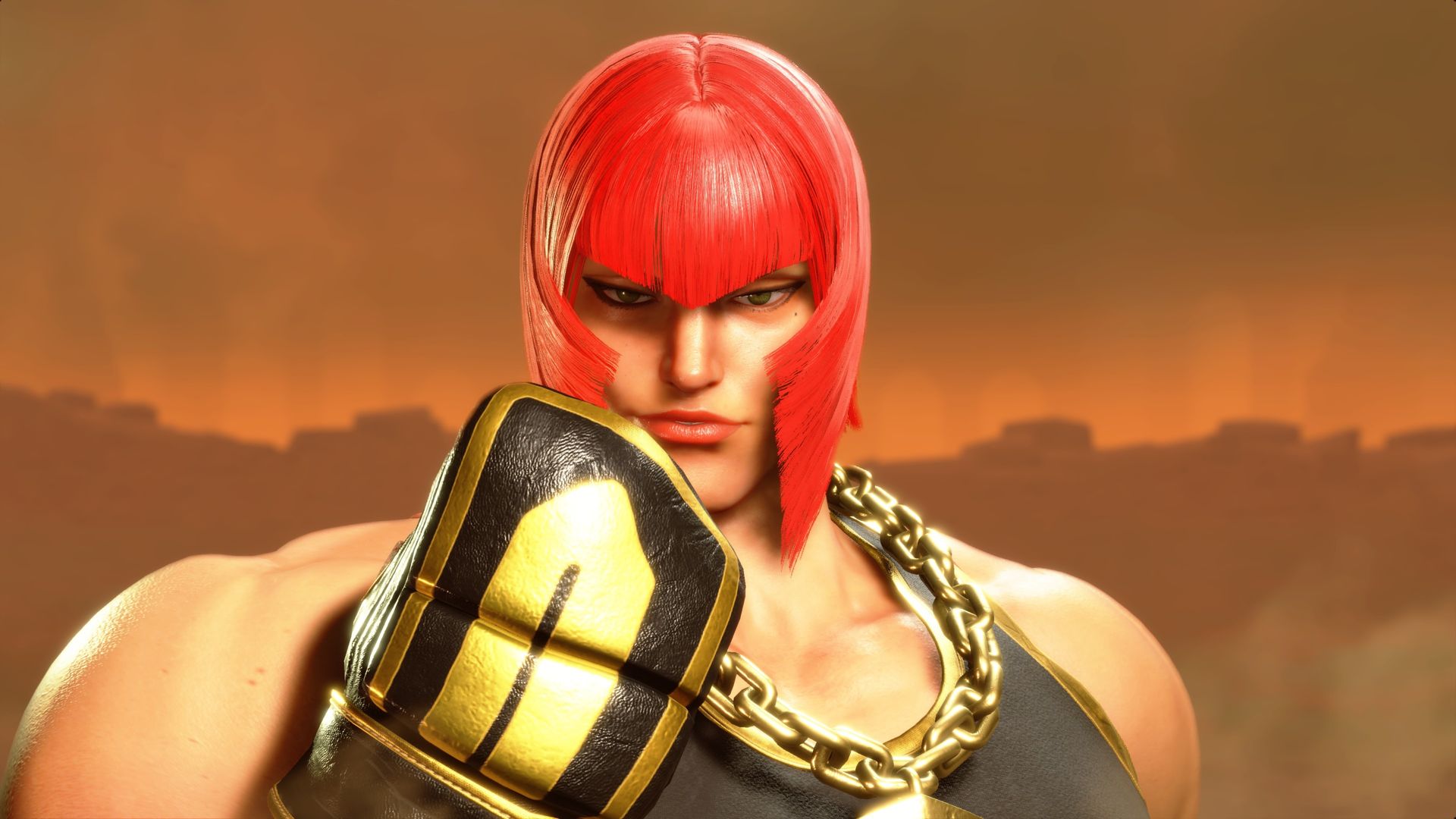
Perhaps among the most eye-catching new characters is Marisa, a huge Italian woman, whose bright red hair has been cut in such a way that it resembles an ancient helmet, like a Corinthian helmet. In fact, the character features a number of references to the ancient world. Indeed, the Street Fighter World Warrior Encyclopedia: World Tour Edition (2024) describes Marisa specifically as an “ancient brawler” (p. 124).
Standing at 203cm tall, Marisa Rossetti “styles herself after the Greek pankration gladiators of ancient times, taking on all comers in an ancient arena known as the Colosseo” (p. 124). Colosseo is the Italian word for the Colosseum, the ancient amphitheatre in Rome that also formed an important part of the movie Gladiator (2000). Her default costume consists of a tank top and shorts that have trims and decorations vaguely recalling ancient dress, especially the pseudo-pteryges (“feathers”) on her shorts.
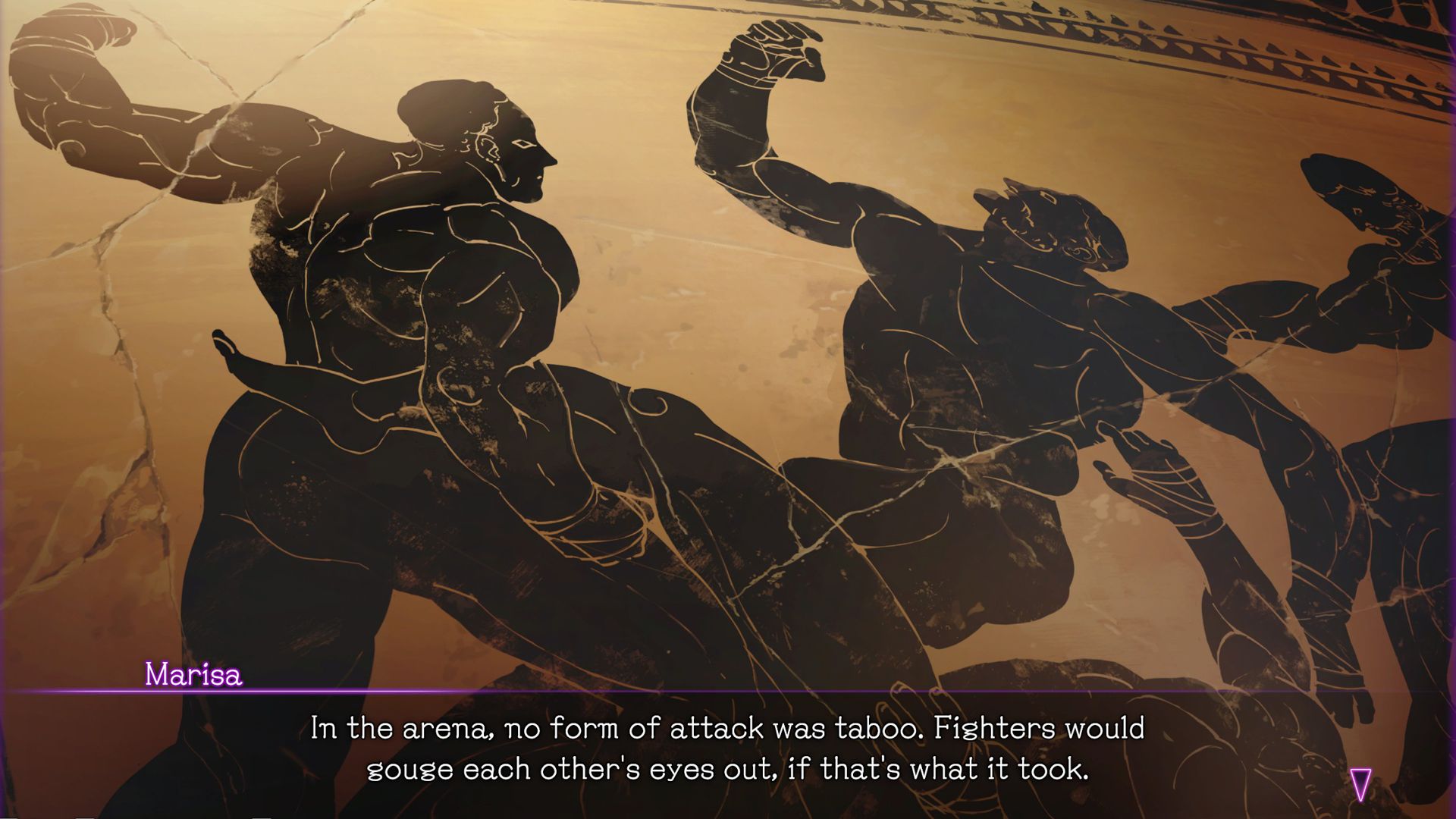
Her design and character traits very deliberately embrace a mishmash of different ancient Greek and Roman elements. Pankration was an ancient Greek combat art in which almost everything was allowed. It featured elements of boxing, kicking, and wrestling, and was therefore a mixed martial art. It was quite violent, with injury being common, and some participants even died during the contests. It’s perhaps no surprise that the Romans incorporated pankration into their games.
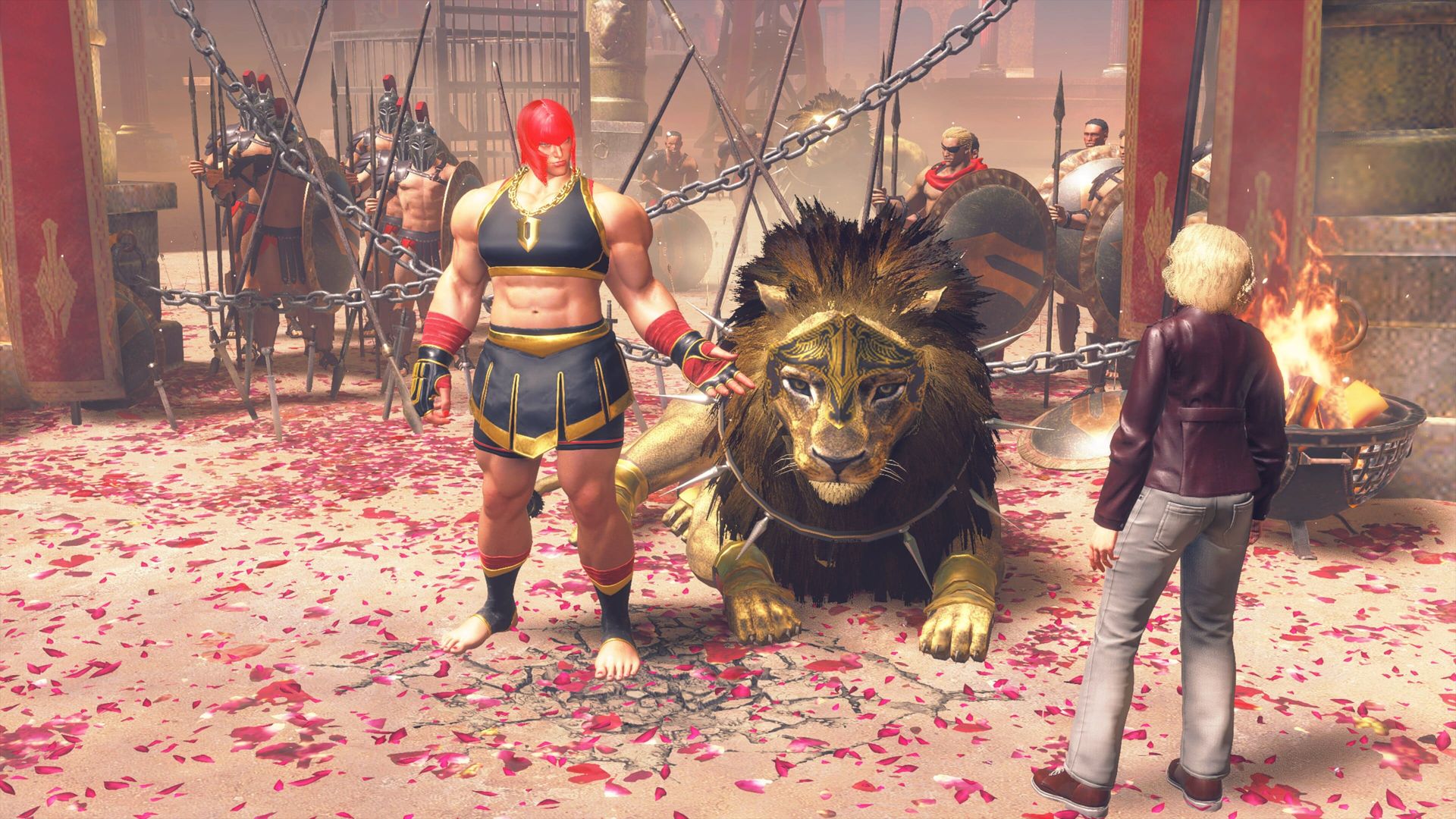
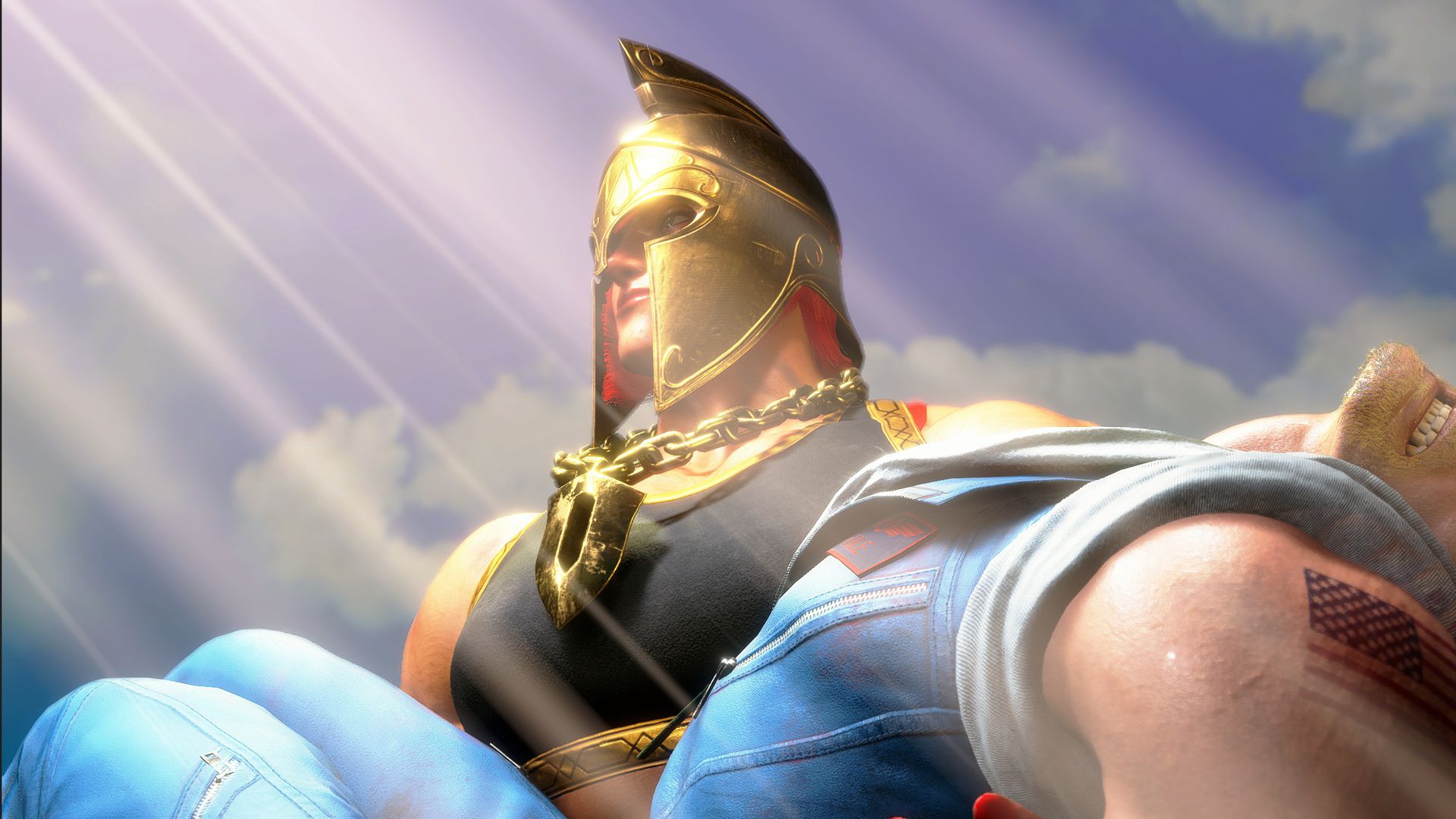
The Encyclopedia provides further details that expand on what we learn from the Arcade story mode and the World Tour modes in Street Fighter 6. Her stage is the Colosseo itself: we see the sand of the arena, the stands of the audience, and various other fighters, some of whom appear to be Greek – most likely supposed to be Spartan – warriors ripped almost straight from the movie 300 (2006), including red cloaks. I initially thought the helmets were more angular, like 300, than they actually appear to be. When Marisa wins a fight, she puts a Corinthian-style helmet on her head that isn’t too bad, relatively speaking.
Indeed, the Encyclopedia claims that Marisa’s “grandfather was a history teacher, which undoubtedly sparked Marisa’s own interest in the legendary fighters of Greece”. Of course it’s her grandfather who was a history teacher: musty, old subjects are the provenance of musty, old people, of course. Why exactly the Italian Marisa, who seems to live in Rome – if Street Fighter’s Colossea is the same as ours – would develop a predeliction for Greek rather than Roman warriors is an issue that is left unresolved.
If you play the game, her stage also features a large lion. This is Marisa’s pet, and he sports the Roman name Lucius. She raised Lucius from a cub and the two used to engage in mock battles. How exactly they came to bond in the first place is never explained, as far as I can tell. Maybe in the world of Street Fighter, lions roam the Italian countryside and she helped it once, similar to how Saint Jerome once removed a thorn from a lion’s paw?
Her stage has predominantly orange colours, and I wonder if this is an attempt to emulate the golden/bronzen look of movies that are set in the ancient world. Funnily enough, the bright orange hue of Marisa’s stage means that some players really dislike it. Especially on a large screen, it can be straining to the eyes.
Marisa’s move list
Like all characters in a fighting game, Marisa has a large number of moves. They each have a name that refers to the ancient world in some way, or is connected to Rome. Her so-called “drive impact” (executed by pressing heavy punch and heavy kick), is called a secutor. In ancient Rome, a secutor was a gladiator armed with a shield and a blade. Of her two types of throws, the backwards one is called “Ponte Milvio”, Italian for the Milvian Bridge, which crosses the River Tiber in Rome.
Marisa sports a large number of “unique attacks”, also referred to as “command normals” in other fighting games. Pressing medium punch into medium punch while jumping is her Volare combo, named after the Italian word that means “to fly”. Pressing down and heavy punch while in the air executes her Caelum Arc: caelum is Latin for chisel. Pushing away from the opponent and pressing heavy punch executes her Magna Bunker, a gut punch: not sure what the reference is here.
Pressing forward plus the medium punch into the heavy punch performs Marisa’s Novacula Swipe; cancelling into a heavy kick instead of a heavy punch turns it into her Novacula Thrust. Novacula is the Latin word for “razor”. Down forward plus heavy punch into the same performs a powerful overhead attack that cannot be blocked crouching: the Malleus Breaker. Malleus is Latin for hammer and, unlike the novacula moves, this gives a good idea of what the attack looks like.
Finally, there is the Falx Crusher, executed by pressing forward plus heavy kick into the same. The falx was an ancient two-handed weapon associated with Thracians and Dacinas. It featured a curved blade that was sharp on the inside edge. Marisa’s move consists of kneeing the opponent, first with the right knee and then with the left (when facing right, so the Player 1 position).
Special moves require a motion plus a button, unless you play Modern controls. Her Gladius is a forward punch that can be charged up: gladius, of course, is the Latin word for sword and used mostly, as a technical term, to denote the swords used by Roman legionaries. Her Dimachaerus is named after yet another type of gladiator who dual wielded swords: Marisa uppercuts her opponent first with one fist and then slams them to the ground with the other.
The Phalanx move sees her jump into the air and then punches downward. For me, this resembles Achilles’ trademark attack as performed by Brad Pitt in the movie Troy (2004). Phalanx, of course, is the word used to denote a particular form of ancient Greek formation. We wrote about this subject so much that I would recommend you just click that link if you want to read more.
Quadriga is the Latin term for a four-horse chariot. Marisa’s move consists of a forward hop into a powerful front kick. Scutum is the Latin word for shield; Marisa’s Scutum is a defensive move that has her cover her head with both arms, but it can be followed up with different button presses. Hitting punch into punch performs her Tonitrus (“thunder”), a two-hit attack, the first of which is an overhead. Pressing a kick button unleashes her Procella (“storm”, “gale”): a sweeping kick. Finally, she can also perform a throw by pressing light punch and light kick together.
As a match continues, characters charge up their super meter. You can charge up to three levels. At level one, you can perform a “super art” called “Javelin of Marisa”, which consists of a powerful punch you can charge up. Her level two super is called “Meteorite”: Marisa jumps into the air with a tackle and then punches her opponent back into the ground. Her level 3 is “Goddess of the Hunt”, a reference to Artemis/Diana: Marisa tackles the opponent, then punches them so hard they fly into the wall.
Closing remarks
As per usual, a lot of the references to the ancient world, both for Marisa and her stage, seem to come from movies. The Spartans in her stage are lifted from 300, her arena owes more to Gladiator than to the actual Flavian Amphitheatre, and her “Phalanx” move looks less like a hoplite line than like Brad Pitt leaping into the air to attack an opponent. The fact that her love is history comes from her grandfather being a history teacher suggests that it’s just not something cool kids are into.
And yet I can’t bring myself to be too grumpy about it. The Latin move names are clearly the work of someone who cracked open a dictionary and had fun, even if a caelum (“chisel”) and a novacula (“razor”) make for slightly baffling attacks. The tension between her Italian home and her Greek heroes never gets resolved, the falx wanders in from Thrace, and nobody explains the lion (as far as I can tell). But the sheer density of references suggests real affection for the material, filtered though it is through Hollywood’s bronze-and-orange haze.
Maybe that’s the honest lesson here. Marisa is a reasonably faithful portrait. Not of the ancient world, of course, but of how the ancient world reaches most people today: as a glorious mishmash, half-remembered from the movies, assembled with more enthusiasm than accuracy. I’d love it if designers started taking the history seriously. Until then, I’ll happily keep losing matches to a 203cm Italian woman who thinks she’s channelling ancient pankratiasts.